City of London Series – Part III – Enter the Norman Conquerors
As I finished the 3rd in this series, Harold Godwin became King on the death of Edward the Confessor. However, not only was his reign a short one but an highly contested one.
His father was believed to have blackmailed Edward in making him the under king, added to which, not only did the Danes see Edward’s death as an opportunity to take back some of the old Daneland, but, more importantly, William, Duke of Normandy, believed his support of Edward in the past was based on a ‘promise’ in 1051 that he, William, would be crowned King of England on Edwards death and further that Harold had sworn, in 1064, to uphold William’s claim.
Well, as we know, Harold defeated the Danes at the battle of Stamford Bridge in September 1066, and despite an heroic march, was overwhelmed by a strong invading force of Normans in October of the same year.
Thus, William claimed the Throne and immediately marched to Westminster Abbey, easily defeating the leaderless Anglo-Saxon resistance he met on the way, and was, on Christmas Day 1066, crowned on the spot, in the Abbey, above where Edward the Confessor was buried. Alfred, archbishop of York performed the ceremony in place of Stigand, archbishop of Canterbury. The Archbishop then “presented” the new king to the people, speaking in English, with Bishop Geoffrey of Coutances speaking in Norman French.
Where did this leave the City of London. It was by now, as I explained in the last blog, no longer the seat of Royalty or Government, but still the base of most key trade and finance in the Country.
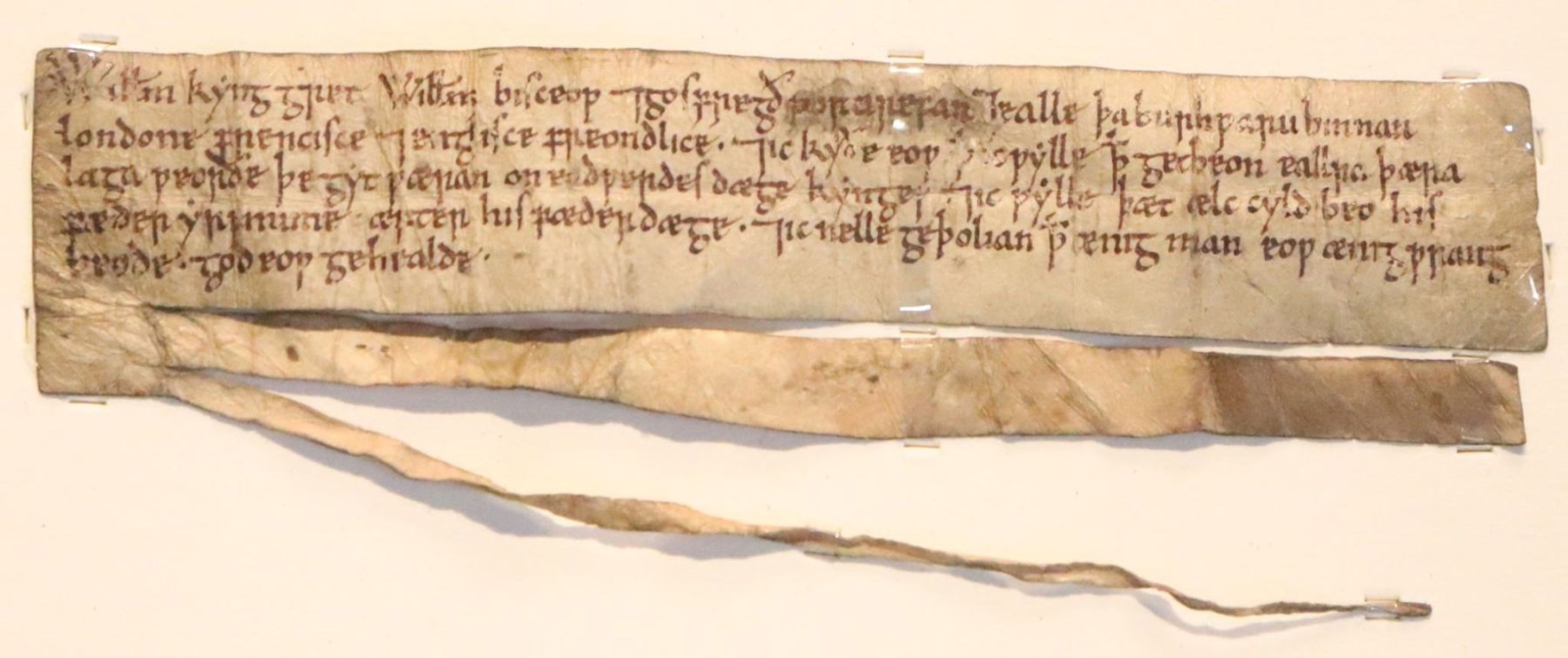
Well, the City of London Archives has, as its oldest document, the “William Charter”. This small piece of Parchment, sometimes referred to, erroneously, as the Magna Carta to the City of London, may be short, and written in Old English, (rather that William’s native French), but it shows the key role the City played in those days, and that William recognised the need for the City to continue in that role.
The William Charter, translated into English by the London Archives, reads “William the king, friendly salutes William the bishop and Godfrey the portreeve and all the burgesses within London both French and English. And I declare that I grant you to be all law-worthy, as you were in the days of King Edward; And I grant that every child shall be his father’s heir, after his father’s days; And I will not suffer any person to do you wrong; God keep you.”
In short, the rights of the City were to be preserved.
However, whilst preserving the City’s rights and those of its Citizens, William did recognise that he had to bolster his control of the Kingdom, and that especially included the Capital.
The Norman way, which was so different to those of the Anglo Saxon’s, was to build Fortresses, normally in the form of a Motte and Bailey. So, it is no surprise when only some 13 months after being crowned, in 1078, William began work on a Castle, in this form, as part of, but on the periphery of, the City. Whilst it took some 20 years to complete, and thus was not finished in William I’s time, and was initially of earth and wood, the design was that it should be made of stone in the Norman manner. This stone was imported from Normandy and built by imported Norman Stone Masons, although the labour would have been ‘English’.
Nothing like it had been see in England before, and it was proof, if that was needed, for the citizens of the City, and the Country, that the Normans, and William in particular, were now in power.
In fact, the White Tower, as it is now known, which was based on the original Motte and Bailey, which it soon replaced, was only one of three Castles William and his lords built around the City.
There was Baynard’s Castle, east of present day Blackfriars, which became a large imposing mansion under the Tudors, but was lost for good after the Great Fire in 1666. Today, the name, at least, remains.
The third Castle was Montfichet’s Tower, which was a fortress on or close to both Ludgate Hill and, apparently, to Baynard’s Castle. It does not appear to have survived more than an hundred year or so, because reports in 1278 reported it to be a ruin.
However, it should be noted at this point that the City did not immediately surrender to William and his forces in 1066. Quite the contrary. They defended the City using the City walls on the North bank and the Thames, basically London Bridge, in the South.
William was unable to force his way across the bridge and so burnt Southwark and set off to the West. Eventually crossing the Thames some way upriver and moving down towards the City from the Northwest.
The English forces met him and were defeated at Berkhamsted, at which point the City capitulated. Nonetheless, as I said, William valued the financial and economic power of the City so issued the William Charter, (transcript above).
The Norman takeover led to French being the language of the elite and an influx of settlers from France. Not all of whom were Norman French. A sizeable Jewish community was formed by settlers from Rouen.
The Norman period actually only lasted some 88 years. From William I coronation on 25th December 1066 until the death of Stephen in 1154.
William I, the conqueror, did not, as I say, live to see the White tower completed as he died in 1087. In fact, he did not stay in England a great deal and died at the siege of Nantes in France.
Nonetheless, he did initiate the Doomsday Book in an attempt to know what he had control over and how much tax he could raise to fund his armies and lifestyle. Interestingly, the City of London was one of the cities and territories not entered in the Doomsday Book. Others include Durham and Winchester. Although there are blank pages which, it is believed, were intended to be used to record these cities. Some have postulated that the City was excluded because of William’ Charter and an assertion that the City was not seen as conquered as such, but I wonder if this can be true?
William the Conqueror was succeeded by William II, also known as William Rufus, in 1087. William II never married and so died childless in an hunting “accident”, (he was very unpopular), in the New Forest in 1100. It was he, however, who saw the completion of the stone built White Tower.
When he died, his brother, Henry I, became king and further developed the inside of the Tower. When Henry died, his two sons had already died in the White Ship tragedy, and so he made his one remaining child, a Daughter, Matilda, heir. In general, it would appear that the Lords did not value having a queen as monarch, so they anointed and crowned Stephen, a grandson of William I, as king. This led to what is referred to as the Anarchy. Two monarchs, with two factions, all vying for power. This was only settled when Stephen agreed to name Matilda’s son, Henry, as his rightful heir.
Henry was the son, as I say, of “Empress” Matilda and her husband Henry Plantagenet. Thus, the Norman line stopped with Stephen, and that of the Plantagenets began.
So, I hear you say, so much for the history of the kings of Norman England, but what happened to the City under their rule.
Well, the City was still very much self-governing, but hemmed in with three imposing fortresses, which in those days must have dominated the skyline in the east, the south and northeast.
London Bridge remained a wooden structure, but Southwark, which William burnt in 1066, was rebuilt, or more accurately, was repopulated and thus buildings re-appeared.
The Normans moved the Capital officially from Winchester to Westminster, which was separated from the City, but which added to the importance of the City because Westminster was not a city, arguably not even a town, which meant the City was the main established center close by. At this time Westminster was the Abbey. The nearby palace, referred to as the Palace of Westminster, which was left over from Saxon times. The palace was, of course, improved by the Normans, in as much as a lot of the wooden structure was replaced by masonry. In fact, the one remaining part of the palace there then, Westminster Hall, was built by William Rufus between 1097 and 1099. Although several Kings added to the hall over the years, (Richard II is responsible for the vaulted roof for example, (1394-1400)), the Hall remains the space created for William Rufus.
As to what went on in the City structurally? Well, a new Saint Paul’s was started. True it was over two hundred year until it was completed, not being finished until the 1300s, but the Normans initiated the St Paul’s, often referred to as “Old St Paul’s” which was only lost in the great fire of 1666.
It is reported that many friaries and monasteries were founded by the Normans in the City. Perhaps the probably the best remaining visible section is those parts of St Bartholomew’s priory in Smithfield.
The City was divided into Wards at this time, with each Ward having a regular meeting, a Wardmote, to discuss local issues and agree limited governance. Something which continues today, The overall governance of the City, however, was given by William I to one of his supporters, Geoffrey de Mandeville, as “portreeve”. The same Godfrey referred to in the William Charter.
Why “Portreeve”? Historically the Saxons had shire-reeves overseeing shires on behalf of the King. So, when William Geoffrey was appointed to oversee the ‘Port’ and the City, he became the portreeve. In some ways this was a precursor of the Sheriffs of the City of London, which were to be initiated in the next century. “Sheriff” being derived from the Saxon “Shire-reeve”.
The Normans also influenced the language. With old English adopting certain French terms, such as “Pork/Porc”, “Beef/Bœuf” and “Muton/Mouton”, into “Middle English”.
In 1133 Henry II became king and founded the Plantagenet line and, as I say, supplanted the Normans. He and his line had significant effect on the city and the country, but that, as they say, is for another day.
Bibliography
https://www.royal.uk/william-the-conqueror
https://www.battlefieldstrust.com/resource-centre/battleview.asp?BattleFieldId=17
https://www.westminster-abbey.org/abbey-commemorations/royals/william-i-the-conqueror
https://www.hrp.org.uk/tower-of-london/history-and-stories/the-story-of-the-tower-of-london/
https://www.castlewales.com/motte.html
https://www.londonmuseum.org.uk/collections/london-stories/how-norman-conquest-changed-london/
https://www.historic-uk.com/HistoryUK/KingsQueensofBritain/
https://www.londonmuseum.org.uk/collections/london-stories/londons-medieval-buildings/
https://www.layersoflondon.org/map/records/montfichet-s-tower
https://www.nationalarchives.gov.uk/help-with-your-research/research-guides/domesday-book/
https://www.parliament.uk/about/living-heritage/building/palace/westminsterhall/